It is defined as the heat transmitted in a liquid or in a gas as a consequence of the actual movement of the heated particles within it.
Example: Quantifies the influence of fluid, surface, and flow properties when convective heat transfer occurs
es: Coeficiente de transferencia de calor por convección
Critical Reynold’s number
Noun
it is associated with the laminar-turbulent transition, in which a laminar flow becomes turbulent.
Example: The Reynolds number at which the flow becomes turbulent is called the critical Reynolds number. For flow over a flat plate.
es: Número crítico de Reynolds
Friction Coefficient
Noun
It is the ratio between the sliding force and the retention force exerted by two surfaces in contact.
Example: For friction the following expression is used: Fr = μN.
es: Coeficiente de fricción
Kinematic viscosity
Noun
Kinematic viscosity is a measure of the internal resistance of a fluid to flow under gravitational forces.
Example: The lower the interaction between the molecules of a liquid, the lower its viscosity
es: Viscosidad cinemática
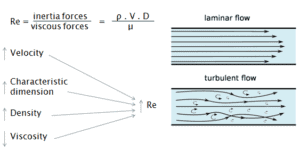
Laminar flow
Noun
Movement of a fluid when it is ordered, stratified or smooth.
Example: Water coming out of the garden hose
es: Flujo laminar
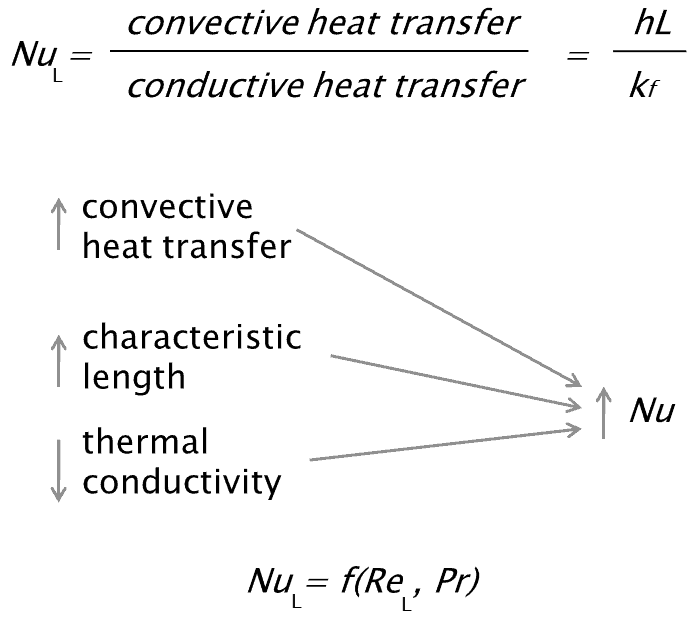
Nusselt number
Noun
Is a dimensionless number that measures the increase in heat transfer from a surface through which a fluid flows (heat transfer by convection) compared to heat transfer if it occurred only by conduction.
Example: is the dimensionless heat transfer coefficient
es: Número de Nusselt
Prandtl number
Is a dimensionless number proportional to the quotient between the diffusion rate of the amount of moment (viscosity) and the thermal diffusivity.
Example: In heat transfer problems the Prandtl number controls the relative thickness of the moment and thermal boundary layers.
es: Número de prandtl
Reynold number
Noun
Is a dimensionless number used in fluid mechanics, reactor design, and transport phenomena to characterize the motion of a fluid.
Example: The Reynolds number is defined as the ratio of the inertial forces.
es: Número de Reynold
Shear stress
Noun
The term shear flow refers to a type of fluid flow which is caused by forces, not the forces themselves.
Example: For a Newtonian fluid, the stress exerted by a fluid in shear resistance is proportional to the strain rate or shear rate.
es: Esfuerzo cortante
Turbulent flow
Noun
Movement of a fluid that occurs in a chaotic way, in which the particles move disorderly and the trajectories of the particles are forming aperiodic eddies, which occurs in a large number of configurations such as channels, pipes, reactors, whether biochemical, physical or nuclear.
Example: The flow of water in rivers or the movement of air near the surface of the earth are typical examples of turbulent flows.